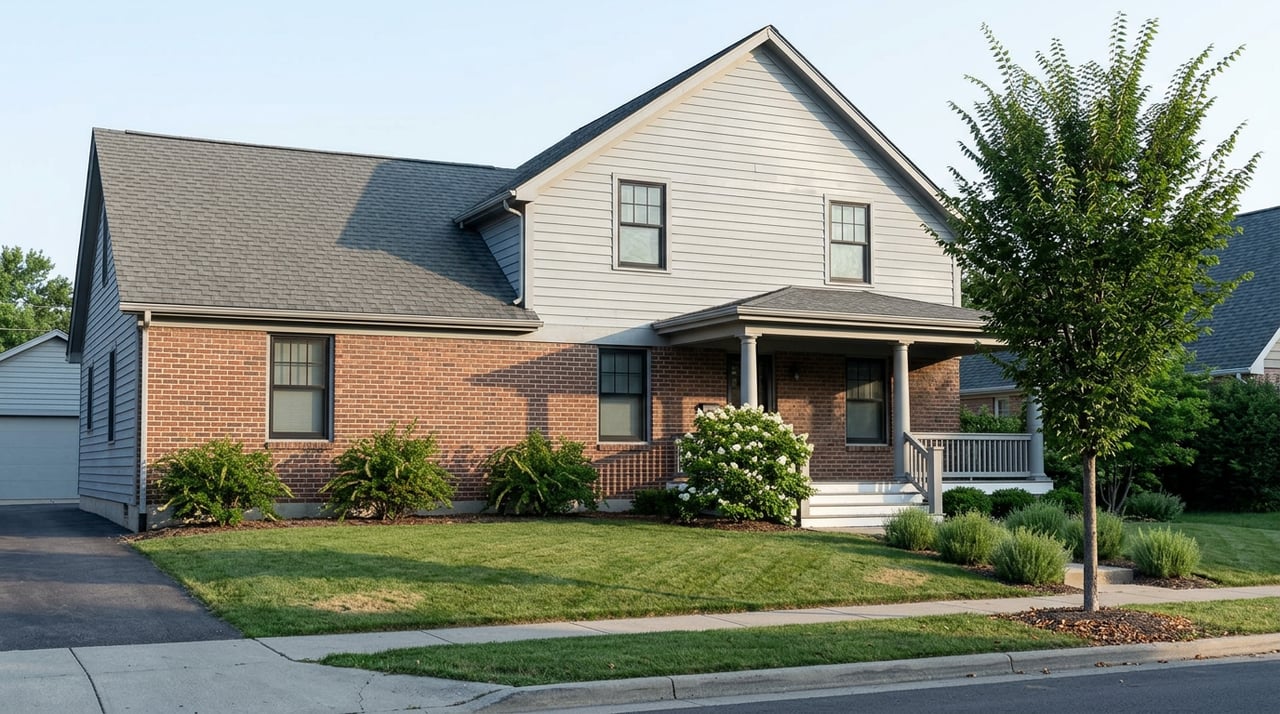
La Grange Rental Property Landlord Rules Investors Should Know
August 27, 2026
August 27, 2026
Buy a single-family house in La Grange and rent it out, and you are operating under a landlord ordinance that a nearly identical house eleven miles away in Naperville does not have to answer to. It has nothing to do with the size of the building, the rent you charge, or whether the tenant works downtown or in DuPage. It comes down to which side of the Cook County line the property sits on.
That distinction catches investors more often than it should. The instinct is to treat "suburban" as a single category: quieter, simpler, less bureaucratic than the city. La Grange and Naperville both fit that description on paper. But since June 1, 2021, one of them has carried a landlord ordinance modeled closely on Chicago's, and the other still has none.
The Cook County Residential Tenant Landlord Ordinance took effect in June 2021 and covers what the county describes as almost all rental units in suburban Cook County, including mobile homes and subsidized units. The exemptions are narrow: owner-occupied buildings of six units or fewer, single-room occupancy housing, hotels and dorms, and one specific carve-out that matters here, a single-family home or condo that is not owned or managed by a company and where the owner or a family member has lived within the past twelve months.
Read that exemption list again. A plain, non-owner-occupied single-family rental in La Grange does not qualify for any of it. Neither does a similar house in Westchester. Both villages sit in unincorporated and incorporated suburban Cook County, and neither made the short list of towns that opted out because they already had their own rules. That list is limited to Evanston, Oak Park, and Mount Prospect. La Grange isn't on it.
So the investor who buys a three-bedroom house on a quiet La Grange street to rent to a family, expecting the same light-touch treatment as any private landlord, is instead subject to a specific set of county rules: a security deposit capped at one and a half times monthly rent, a 30-day window to return that deposit after move-out with an itemized accounting of any deductions, a two-day notice requirement before entering the unit, and a late fee capped at $10 a month on the first $1,000 of rent plus 5 percent of any amount above that. Get the deposit handling wrong and the ordinance allows the tenant to recover twice the deposit plus attorney's fees.
Move that same purchase into Naperville and the picture changes, not because Naperville chose to deregulate, but because DuPage and Will counties, where Naperville sits, never adopted anything comparable to Cook County's RTLO. A Naperville landlord answers to Illinois state law and nothing more local than that.
State law is not nothing. The Illinois Security Deposit Return Act was amended effective January 1, 2024, and that amendment removed the old threshold that had limited the law to buildings with five or more units. Every residential landlord in Illinois, regardless of portfolio size, now has to itemize deductions within 30 days of a tenant vacating and return the balance within 45 days, with two-times-damages exposure plus attorney's fees for bad-faith handling. That baseline applies in Naperville exactly as it does everywhere else in the state.
What Naperville doesn't have is the second layer: no county-mandated cap on the deposit amount, no late fee ceiling, no two-day entry notice written into a local ordinance. A landlord there is working from one rulebook. A landlord in La Grange is working from two, state law plus the county ordinance layered on top, and the county layer is the stricter of the two on deposit return timing, at 30 days instead of 45.
Eviction timing tends to follow the same pattern. Naperville properties fall under either the 18th Judicial Circuit Court in Wheaton or the 12th Judicial Circuit Court in Joliet, depending on which county line the property sits on, and both are generally regarded as faster-moving dockets than Cook County housing court. That's not a knock on either court. It's a function of caseload and local ordinance complexity, and it's another line item an investor comparing the two markets should actually price in rather than assume away.
Chicago's Residential Landlord and Tenant Ordinance, the model Cook County borrowed heavily from when it wrote its own version in 2021, has been on the books since 1986. It covers most Chicago rentals with the same basic exemption for owner-occupied buildings of six units or fewer, but it adds a requirement neither Cook County's RTLO nor Illinois state law imposes: annual interest on the security deposit, at a rate the city comptroller sets every January.
For 2026, that rate is 0.01 percent, the same figure it has been every year since 2016. On a $2,000 deposit, that works out to 20 cents of interest a year. Tenant attorneys have started asking why the rate hasn't moved even as bank savings rates climbed considerably over the past several years, and a FOIA request into the comptroller's methodology was filed with the city in early 2026. Whatever comes of it, the number as published today still triggers the same strict-liability consequences: miss the annual interest payment or the 45-day return deadline in Chicago, and a tenant can recover double the deposit plus attorney's fees, the same shape of penalty Cook County built into its own ordinance three and a half decades later.
None of this shows up in a median price comparison between La Grange and Naperville, and none of it should scare an investor away from either market. What it does is add a real, quantifiable line to the operating side of a pro forma that a lot of buyers skip.
| Chicago RLTO (since 1986) | La Grange and Westchester, Cook County RTLO (since 2021) | Naperville, state law only | |
|---|---|---|---|
| Covers a plain single-family rental | Yes, unless owner-occupied 6 units or fewer | Yes, unless owner-occupied 6 units or fewer, or owner lived there in the past year | Yes, no unit-count exemption since the 2024 amendment |
| Deposit return deadline | 45 days | 30 days | 45 days |
| Deposit cap | Not specified locally | 1.5x monthly rent | Not specified locally |
| Late fee cap | Not specified locally | $10/month on first $1,000 rent, plus 5% above | Not specified locally |
| Landlord entry notice | 2 days | 2 days | No local rule |
| Annual deposit interest required | Yes, at the city's published rate (0.01% for 2026) | Not part of the RTLO's core requirements | Only for portfolios of 25+ units statewide |
| Penalty for mishandled deposit | Up to 2x deposit plus attorney's fees | 2x deposit plus attorney's fees | 2x deposit plus attorney's fees |
Read across that table and the practical difference between La Grange and Naperville isn't dramatic, but it's real: a tighter deposit-return clock, a hard cap on what you can charge and collect in late fees, and a documented entry-notice requirement that a lease drafted for a Naperville property wouldn't necessarily need to include. None of it is expensive to comply with. All of it is expensive to get wrong, since the penalty structure in both jurisdictions runs to double damages plus legal fees.
The bigger point is what the comparison reveals about how to actually evaluate two suburbs that look interchangeable from a listing photo. Distance from the Loop tells you about commute time. It tells you nothing about which rulebook governs your lease. The county line does that, and for a rental purchase, the county line is doing more work than most buyers give it credit for.
Does the Cook County RTLO apply if I plan to live in one unit of a La Grange duplex? If the building has six units or fewer and you occupy one of them, it falls under the owner-occupied exemption and the RTLO's substantive provisions don't apply, though the ordinance's anti-lockout protections still cover every rental unit in the county with no exceptions.
Is Westchester really treated the same as La Grange? Yes. Both are suburban Cook County municipalities, and neither is on the short list of towns, Evanston, Oak Park, and Mount Prospect, that were exempted because they already had their own comparable ordinances in place before 2021.
Does Naperville having no local ordinance mean a landlord there has no real obligations? No. State law still applies in full, and the 2024 amendment to the Illinois Security Deposit Return Act closed the old loophole that let small landlords ignore it. What Naperville lacks is the additional county-level layer, not baseline tenant protections.
If you're weighing a rental purchase across these markets and want the operating side worked through before you make an offer, Alejandro Trujillo Group can walk you through what a specific property actually costs to run, not just what it costs to buy. Start with a Get Your Instant Home Valuation on the property you're considering, or reach out directly to talk through the numbers on a La Grange, Westchester, or Naperville rental before you write an offer.


With a focus on continuing to educate their agents and continued attention to an amazing culture they have built, Alejandro & Mike have a huge vision for RE/MAX NEXT and their clients and work every day to achieve it.

ALEJANDRO TRUJILLO
LAKEVIEW 3401 N Broadway St Chicago IL 60657 GOLD COAST 1207 N Dearborn St Chicago IL 60610